Why continuous reconciliation requires expertise at the intersection of accounting and data engineering and how llms make that expertise scalable.
Chasing the 0: The Race That Moves the Finish Line
Date
Author
Nazim Morera, CEO of Koinju
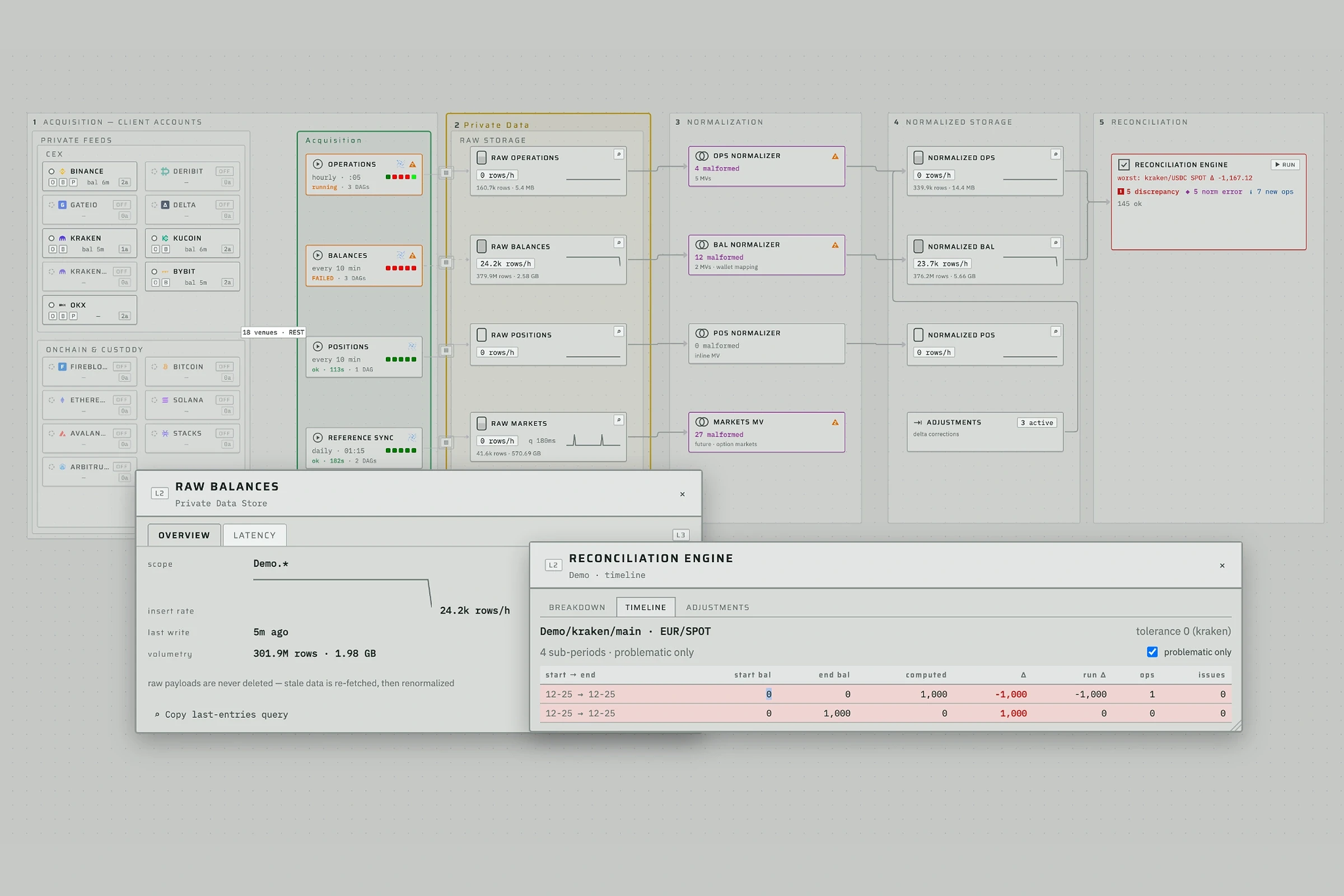
Financial source systems produce structured data whose syntax is unambiguous but whose semantics are often opaque. Crypto exchanges make this problem especially visible: field names mislead, type codes are undocumented, and sign conventions change without notice. At Koinju, we reconstruct meaning through abduction (inference to the best explanation) constrained by a single reconciliation invariant: when replayed across the relevant history, a proposed interpretation must preserve a zero reconciliation delta between observed balance movements and the net effect of the corresponding normalized operations.
The standard architecture
Financial data platforms, Koinju included, run some version of the same pipeline:
Ingest data from financial source systems, including exchange APIs and blockchains
Normalize it into a canonical schema
Reconcile observed balance movements against the net effect of normalized operations
Flag discrepancies (Δ ≠ 0)
Resolve discrepancies
Steps 1 to 4 are automated and scale through software. Step 5 is where scaling becomes expensive.
Discrepancies are not bugs
A reconciliation delta is not a software bug. It is an interpretation failure: a case where our model of what a source system’s data means diverges from what the source system actually did. A commission field that is actually a rebate, a type code whose semantics changed between API versions or even a sub-account transfer visible from the master account’s endpoint but invisible from the sub-account’s…
Each discrepancy is a gap between two independently designed representations of the same economic activity. Inferring what a field means, detecting when a convention has changed, and mapping one ontology onto another is the problem. The pipeline handles syntax but the discrepancy lives in semantics.
This is not specific to crypto. In its 2025 SFTR data-quality review, the CSSF noted that “validation rules are not intended to identify all potential errors and omissions” and recommended reconciliation across internal systems, counterparties, service providers, and trade-repository data.
The human workaround
Most platforms handle step 5 through human investigation. If the discrepancy cannot be resolved programmatically, the accounting or operations team books a manual reconciling adjustment.
This can be an appropriate period-close treatment when the cost of investigating an immaterial discrepancy is disproportionate to its value. It closes the books, leaving the underlying interpretation problem untouched.
Consider the cost of professional accounting services across Europe, together with the control and audit review that a reconciling adjustment may require. Spending 2 or 3 hours investigating a 0.003 BTC delta may be difficult to justify.
So a reconciliation process that depends on human investigation can only operate economically in batch mode. Exceptions must be grouped into periodic review cycles because each investigation carries not only the expert’s billed time, but also the cost of reconstructing the customer-specific accounting context and the mapping between the source system’s data and the customer’s books.
The clock is shrinking
The surrounding financial system is accelerating. MiCA requires custodial crypto-asset service providers to maintain client position registers, record relevant movements promptly, and segregate client assets. European securities markets will also move from T+2 to T+1 on 11 October 2027, further compressing the time available for matching, funding, reconciliation, and exception resolution.
The point is not that regulation explicitly mandates a continuously zero reconciliation delta. It is that institutions increasingly need positions that can be explained sooner than a human-led process can economically deliver. That mismatch is where the compounding trap begins:
External pressure for faster reconciliation → more frequent checks → unresolved discrepancies recur and surface more often → more human investigation → slower resolution → reconciliation falls behind the required frequency → pressure increases…
In a sense, the snake eats its own tail…
The complexity is in the wrong place
The transformation pipelines are not algorithmically complex. No dynamic programming, no graph traversal. Conditional branches. String comparisons. Sign flips. The computational cost is negligible.
The complexity of data interpretation is not computational but relational. It lives in the inference from observed patterns to intended semantics. In the mapping between independently designed ontologies. In the detection of silent convention changes.
Resolving these discrepancies requires the ability to distinguish source-data interpretation issues from cases that require accounting judgment and to route each one to the appropriate expertise.
For fifty years, computer science built tools for algorithmic complexity. These tools are mature, but they are not the solution. Institutions are now expected to explain positions sooner, while settlement cycles are shortening. Human review cannot economically keep pace.
What breaks the cycle
A LLM performs statistical inference over learned relational structures, exactly the kind of approach this problem demands.
Three properties make language models particularly suited to this cross-domain problem:
Breadth. A specialist usually knows a limited set of financial source systems. A language model draws on patterns learned across a much broader public corpus, helping it relate unfamiliar cases to structures seen elsewhere.
Speed at negligible marginal cost. The 0.003 BTC discrepancy that a human may rationally ignore? In our observations, the model investigates it in minutes, at negligible cost compared with specialist review. This pushes the cost-benefit threshold for investigation much lower.
The task is inferential, not generative. The model is not asked to invent. It is asked to relate: a field to its documentation, a pattern to a known pattern, an anomaly to an existing category, a raw payload to a normalization rule. This is semantic matching at scale, exactly what the architecture was designed for.
Koinju handles upstream financial-data semantics across the investment-management ecosystem, allowing accounting and control professionals to focus on cases that require financial judgment.
From investigation to resolution
Continuous reconciliation changes the operating model: exceptions are investigated as they arise and routed to the appropriate expertise, rather than accumulated for period-end review.
Δ ≠ 0 → model investigates → proposes a root cause and recommendation → where implementable, a rule is tested across the relevant history → appropriate expert validates → rule encoded
Root cause resolved → recurring exception eliminated
The LLM proposes, the invariant disposes. No interpretation rule is encoded until it has been tested across the relevant history, preserves Δ = 0, and has been validated by the appropriate expert.
Data-semantic issues can therefore remain in the data layer. Cases requiring accounting judgment or action by another owner are escalated with the evidence and recommendation already prepared. Human expertise moves from open-ended investigation to focused review and decision.
Continuous reconciliation becomes possible
Reconciliation can move from periodic to continuous, with exceptions detected and routed as they arise.
Fund accounting and reporting (including regulatory and tax reporting) can rely on a continuously reconciled dataset rather than a manually adjusted snapshot.
Audit trails are cleaner. Every interpretation is documented, every hypothesis is testable, and every rule is traceable to the evidence, historical replay, and expert validation that supported it with the right data layer.
The system meets these operational demands not by scaling headcount, but by making financial-data investigation scalable and routing each exception to the expertise it requires.
The finish line stops moving. Reconciliation catches up.
Koinju provides institutional-grade financial data infrastructure: reconciliation, pricing, and reporting for funds, banks, and auditors across traditional and digital assets. koinju.io
